Across the intermountain region, in the states of Utah, Colorado, and New Mexico, early 20th-century immigrant Greek America still features in public spaces beyond community settings. A visitor could piece together a collage of its traces interspersed across American museums, archives, paintings, cemeteries, and statues of immigrant labor leaders. A long-gone past meanders its way into our present through material objects, images, oral testimonies, and printed words.
Early one morning in Fall 2026, while visiting Salt Lake City, a friend of mine and I made a point of exploring Magna, only a 25-minute drive away. It was only recently that the town registered in my mental map of immigrant Greek America in the region. My personal imaginary includes Helper, Utah, the place where historian Helen Papanikolas was raised; the Hellenic Cultural Museum in Salt Lake City; the site of the Ludlow massacre, near Trinidad, Colorado; and the cemetery in Price where the remnants of the Greek miners killed in the Castle Gate mine explosion in 1914 were laid to rest. It’s a geography dotted with visible and invisible remains.
It was a family story that added Magna to my personal geography of the region. Reminiscing about his immigrant ancestors, historian Zeese Papanikolas speaks about his newly married grandmother, freshly arrived from Greece, moving into her new home in town. The move came with an arrangement not uncommon among immigrant money-saving adaptations. It was a home where “she settled down to life not only with her husband, but two boarders.” The home “still existed when cousins who lived in Magna as children saw it, nothing more than a glorified toolshed in the backyard of another house.” It was this passage, imprinted on me, that propelled my visit.
According to historian Katie Calton, in “Kennecott's Greek History,” (https://www.intermountainhistories.org/items/show/155), Magna was a robust mining town early in the 20th century, known for its closeness to Bingham Canyon Copper Mine—known as Kennecott Copper Mine among locals—the “largest human-made excavation and the deepest open-pit mine on Earth.” It was a magnet for immigrants. “In 1904 there were 2,000 [Greek] names on the payroll at Bingham Canyon,” which increased to 3,239 by 1912, making up 37.4 percent of the labor force.” Local Greek Americans still remember a grandfather or great-grandfather working in the industry.
Historians in the region reconstruct fragments of early immigrant life in the town. “Enclaves of Greek families,” Katie Calton writes, “formed in Magna, which was referred to as ‘Little Greece.’ … The Ku Klux Klan’s branch in Salt Lake County was active around the mining towns that attracted Eastern European immigrants, and some Greek immigrants in Magna tell of the KKK’s white cross burning at the end of the street.” I wonder whether Zeese Papanikolas’s grandmother experienced such an incident. If so, how did she feel?
The early 20th-century immigrant experience in the intermountain West moves me deeply, even haunts me, inexplicably. It was a period when millions of immigrants from rural Southeastern Europe entered the United States, encountering the industrial modernity of America. It set in motion an array of dramatic transitions. From farm work to industrial labor. From embeddedness in family and community to alienating situations. It involved negotiating a new language and coping with new rules for conducting oneself. Exploitation and virulent nativism made everydayness a harsh reality, leading to new political behaviors—joining labor unions. The scale of these transformations dwarfs me.
Regional memory of this past still exists, yet it is fading. I was curious about how its echoes are expressed in Magna. Who does the remembering? Our itinerary included a visit to the must-see Magna Ethnic and Mining Museum, a stroll in the town, and a ride to the Kennecott Copper Mine, which, to our chagrin, was closed to visitors.
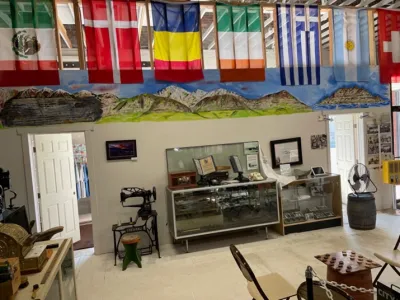
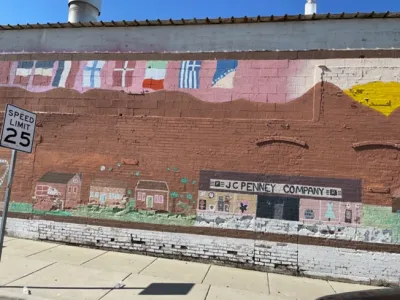
The museum honors the immigrants for their contributions to the country, a conventional tribute; their labor is recognized as a force for building the nation’s economic might. Prominently displayed are more than twenty national flags corresponding with the origins of the immigrants. This visual narrative also dominates the town’s square in the form of a mural. Civic institutions inscribe the immigrant past in the identity of the place.
In the museum’s interior, under the rags-to-riches iconography, we encounter scattered fragments of the past: family photographs, autobiographical snippets, genealogical trees, business brochures, vignettes of acculturation, and stories of economic mobility.
Stepping outside, strolling along the street, beyond the celebratory mural, the urban landscape testifies to the disappearing immigrant presence. One business announcing ethnicity via the name of its owner is abandoned. Another one, also marked ethnically, appears to be in a state of neglect if not unoccupied. The few traces of the past are crumpling in front of our eyes.
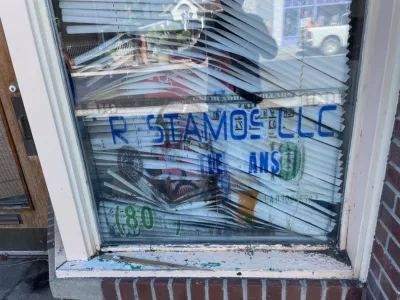
I venture into a solitary walk to observe and take all this in. The initial knot in the stomach tightens. Witnessing the ruins of the immigrant presence, I contemplate the enormity of the historical weight of its past. Vast labor, losses, aspirations, dreams pursued, achieved or unfulfilled, lives violently interrupted. What does one do with a past dissipated to a shadow of itself?
We do have a valuable historical record of the early twentieth century immigrant Greek America. In the intermountain region, an image, a canyon, a town, a sealed mine, a list of names in a historical marker, a series of graves, a historical figure come alive through the labor of historians who, in the 1960s, 1970s, and 1980s, turned family lore and eyewitness accounts of immigrant life into projects documenting it.
But another layer of absences presses on me, further unsettling things. With small-scale yet vital exceptions, no generation of researchers has shown an interest in the present of Greek America’s intermountain West.
If the past hangs in public ruins and museum displays, the research community has abandoned its future. A historical gap, unbridgeable, elusive. A gap that makes me gasp.


